
FDA CVM new regulations implemented: pet food nitrogen filling equipment needs to submit microbial challenge test
On August 13, 2026, the U.S. FDA’s Center for Animal Medicines (CVM) began to implement a new compliance requirement involving manufacturers and exporters of pet food nitrogen filling equipment. Based on known information, relevant equipment is now required to provide a third-party certified microbial challenge test verification report to prove the nitrogen filling process’s ability to inhibit aerobic bacteria, molds and yeasts. For China's export-oriented nitrogen-filled packaging equipment suppliers targeting the US and European markets, this change is directly related to access, certification coordination and customer factory inspection requirements, and deserves continued attention from the industry.
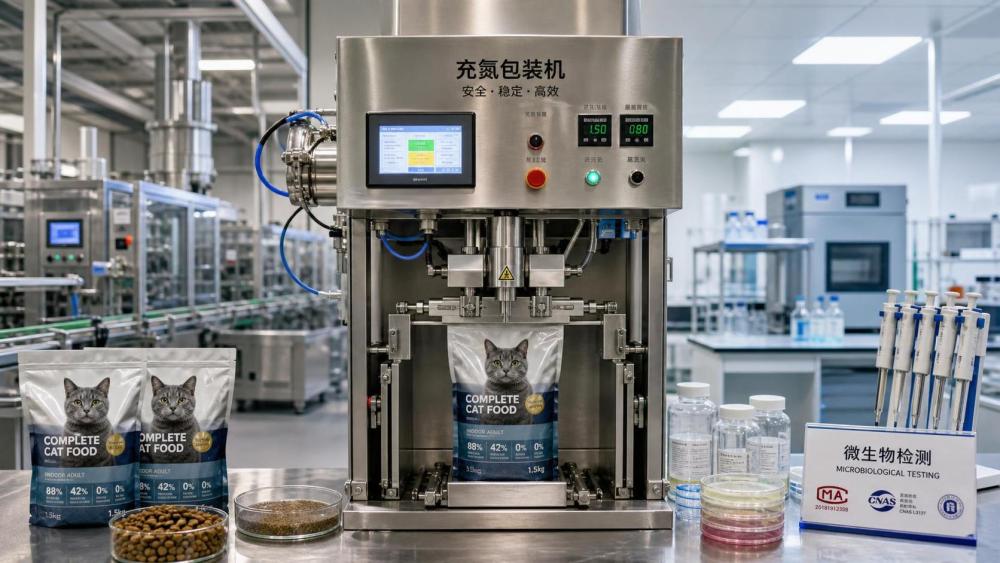
This compliance requirement has pointed to changes in the device verification method
Confirmed information shows that the FDA CVM will officially implement new regulations on August 13, 2026, applicable to pet food nitrogen filling (Nitrogen-flushed Pouch Packers) related equipment manufacturers and exporters. The new regulations require the submission of a third-party certified Microbial Challenge Test verification report to prove that the nitrogen filling process can effectively inhibit the growth of aerobic bacteria, mold and yeast during the shelf life.
Judging from the existing information, this is not a simple document supplement, but includes whether the equipment has antibacterial verification capabilities into a clearer compliance review framework. For equipment companies, testing agencies, certification service providers and purchasers in the export chain, the focus will extend from the equipment parameters themselves to verification reports, test methods and third-party endorsements.
From supply to factory inspection, it is not just the equipment manufacturers that are affected
Export equipment companies have to face more direct access review
For companies that directly export nitrogen-filled pet food equipment, the impact is first reflected in the compliance access link. Whether the equipment can enter the target market no longer only depends on mechanical performance and delivery capabilities, but also whether it can provide a microbial challenge test report that meets the requirements, and whether the relevant technical documents can support customer review.
The purchaser will include verification materials as prerequisites
From a procurement perspective, European and American customers may pay more attention to third-party verification materials when making selections, factory inspections and technical assessments. In other words, procurement decisions are not just about comparing equipment prices and production capacities, but also simultaneously checking whether verification reports, test logic, and delivery documents are complete to avoid subsequent compliance risks that may affect production.
Higher requirements for the connection between certification and testing services
For certification-related companies and testing agencies, such new regulations usually increase the requirements for document consistency and test traceability. From the analysis, when preparing FDA compliance materials, companies may need to process test reports, process descriptions, equipment technical documents, and customer factory inspection materials at the same time. Any inconsistency may slow down the pace of the review.
The collaborative certification path will be reorganized
The event summary has clearly mentioned that this requirement will affect the FDA compliance access of China’s export-type nitrogen-filled packaging equipment suppliers, the CE/FCC collaborative certification path, and European and American customer factory inspection standards. What deserves more attention now is whether the file logic between different certifications can be consistent to avoid conflicts when one set of data corresponds to multiple markets.
Which materials companies need to pay more attention to now
Third-party test reports must be prepared before delivery
For companies that plan to continue exporting related equipment, the most realistic action is to confirm the availability of microbial challenge test reports in advance instead of waiting for customers to place orders. Because once the report becomes a condition for access or factory inspection, the delivery cycle, contract signing rhythm and prototype confirmation will be affected.
Technical documents must be consistent with verification conclusions
Enterprises also need to pay attention to whether the technical description, equipment configuration, process description and test conclusions are consistent. If the technical specifications of the same equipment deviate in different market documents, the purchaser and auditor will often require re-clarification, which will affect the negotiation efficiency and acceptance progress.
Supplier qualifications and after-sales response will also be re-examined
For the export trade link, customers usually include quality traceability and after-sales support together. From an analysis point of view, this type of rule change will make supplier qualifications no longer just a formal requirement of complete documents, but also the ability to continuously respond to subsequent random inspections, reviews and supplementary document requirements.
Is this more like an execution signal, or is it a change that still needs to be observed?
The editor believes that this information is more suitable to be understood as an execution signal that has been implemented, rather than just staying in the rule discussion stage. Because the known information clearly gives the effective time, applicable objects and reporting requirements, it shows that the regulatory focus has shifted from "whether the device is suitable" to "whether the device has been proven to have verifiable antibacterial ability."
However, from an industry enforcement perspective, there are still several things that need to be observed, including the specific acceptance criteria for third-party certification, the consistency of test methods, the requirements for reporting forms during customer factory inspections, and whether additional supplementary documents will appear in different markets during certification collaboration. For enterprises, the more reasonable approach now is not to judge that the impact has ended, but to regard it as a continuous verification matter after entering the actual enforcement cycle.
How should the industry understand this change
Overall, the core of this change is not to add a separate document, but to bring the compliance certification of pet food nitrogen filling equipment closer to the level of verification of real process effects. For export enterprises, certification agencies, testing service providers and purchasers, the follow-up work will focus more on data consistency, test acceptability and pre-delivery compliance preparation. At present, it is more appropriate to understand this information as a clear signal for enforcement, and at the same time continue to track changes in specific review standards.
The scope of the data this article is based on
This article is generated based on the information title, event time and event summary provided by the user. It does not cite specific companies, amounts, regulatory numbers or source links that do not appear in the input. Types of sources typically associated with such events include regulatory agency announcements, official compliance statements, standards or certification documents, customs and trade authority information, industry association notices and authoritative media reports. Since no specific official source link is provided in the input, the relevant details, certification enforcement standards and market feedback still need to be continuously verified.
Related News
- Smart Pet Feeders: Which Features Matter for Reliable Daily Feeding?Sep 13, 2026Companion Animal IoT Strategist
- How U.S. Pet Food Brands Should Evaluate Freeze Dryers for Capacity and Product QualitySep 12, 2026Pet Nutrition Extrusion Scientist
- How does rising companion animal health demand influence Vet Doppler Ultrasound & X-Ray equipment CAPEX planning for 2026–2027?Sep 12, 2026Veterinary Diagnostic Architect
- Is small-batch pet food freeze-drying profitable using Pet Food Freeze-Drying Chambers with <50 kg/h capacity?Sep 12, 2026Pet Nutrition Extrusion Scientist
- How can High-Fresh-Meat Twin-Screw Extruders safely process >70% raw-meat pet food formulations without thermal degradation?Sep 12, 2026Pet Nutrition Extrusion Scientist
- What are the main subscription-related risks for pet tracking devices used in clinic-managed patient monitoring programs?Sep 13, 2026Ms. Vivienne Cross