
When Does Hydrotherapy Improve Postoperative Rehabilitation in Dogs?
When Does Hydrotherapy Improve Postoperative Rehabilitation in Dogs?
Postoperative animal rehabilitation hydrotherapy can help dogs regain mobility when pain, swelling, muscle loss, or limited weight-bearing slow conventional recovery. By using buoyancy, controlled water resistance, and supervised movement, hydrotherapy may support safer early exercise after orthopedic, neurologic, or soft-tissue procedures. For veterinary operators, the key is knowing when a surgical incision is stable, when pain is adequately managed, and when a tailored aquatic program can improve function without compromising healing.
The question is not whether water is inherently beneficial. It is whether a particular dog is ready for a specific form of aquatic exercise on that day. A dog recovering from cranial cruciate ligament surgery, hip surgery, fracture repair, intervertebral disc disease, or tendon intervention may all appear to need “rehabilitation,” yet their restrictions can be very different. The surgical approach, implant stability, tissue healing stage, neurologic status, wound condition, body condition, temperament, and home environment all affect the decision.
For clinics and rehabilitation operators, hydrotherapy works best as part of a coordinated postoperative plan rather than as a stand-alone service. The referring surgeon, rehabilitation clinician, veterinary nurse or technician, and handler should be working from the same practical restrictions: what movements are allowed, what loading is acceptable, which signs require stopping, and how progress will be measured.
Why Water Can Change the Early Recovery Equation
Land exercise asks a recovering dog to manage gravity, balance, joint loading, and propulsion at the same time. Water changes that equation. Buoyancy reduces effective weight-bearing, while the resistance of water creates a controlled demand on muscles through movement. Warm water may also make some dogs more comfortable enough to move with a smoother gait, although water temperature must be managed carefully and should never be treated as a substitute for appropriate analgesia.
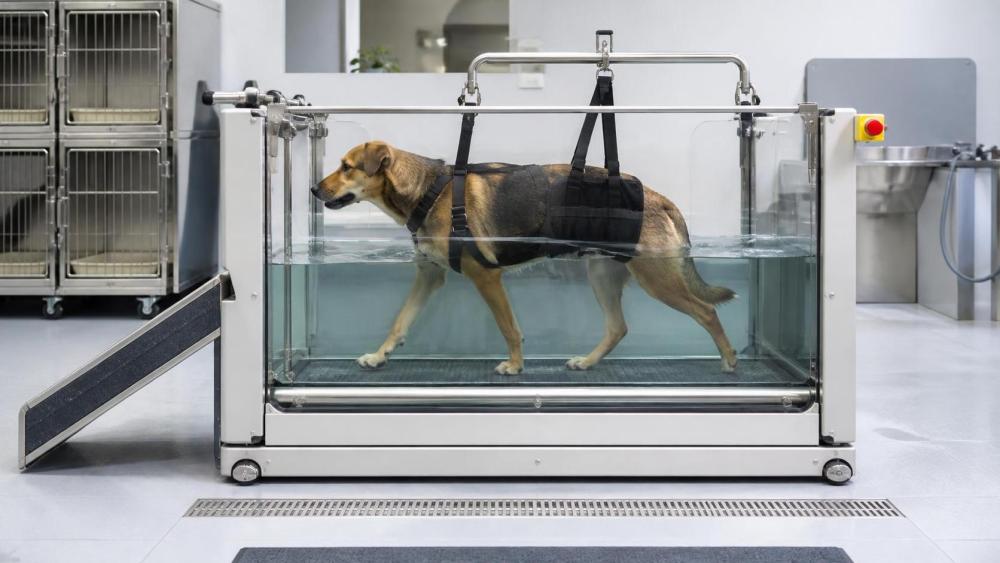
An underwater treadmill is often useful when the goal is repeatable, guided walking. Water depth can alter the amount of unloading and the movement pattern, while belt speed can be adjusted to the dog’s coordination and confidence. This gives the operator more control than free swimming, particularly for dogs that need deliberate limb placement after surgery. The dog is not simply “getting exercise”; it is practicing a selected gait under reduced load.
Swimming can have a place in later rehabilitation, but it is not automatically the gentler option. It requires active trunk control, coordinated limb use, and a different range of joint motion. Some dogs paddle asymmetrically, panic, fatigue quickly, or aggravate a painful area through uncontrolled effort. For a fresh orthopedic patient, a structured walking environment is often easier to monitor than open-water activity.
The useful clinical effect comes from matching water depth, duration, speed, support, and handling to a defined rehabilitation objective. That objective might be restoring comfortable weight acceptance, maintaining joint motion, rebuilding endurance, improving gait symmetry, or preserving conditioning while land activity remains restricted.
The First Decision Point: Is the Dog Ready to Enter the Water?
A postoperative timetable alone is not enough. Some dogs heal cleanly and settle into controlled activity as expected; others have persistent swelling, delayed wound closure, medication changes, poor tolerance of handling, or complications that make hydrotherapy inappropriate for the moment. Clearance should come from the treating veterinarian or surgeon, with the rehabilitation plan reflecting the actual procedure and recovery findings.
Before the first session, operators should confirm that the incision is closed and suitably healed for water exposure, with no drainage, concerning redness, wound separation, or unresolved infection concern. A wet environment can complicate wound management, and covering a problem incision is not an adequate workaround. If there is uncertainty, delay the session and seek veterinary review.
Pain control also matters. A dog that is reluctant to bear weight, trembling, guarding a limb, vocalizing during handling, or showing marked stress may not benefit from being encouraged through a water session. Conversely, an animal that seems comfortable because it has received analgesic medication still needs observation; medication can reduce visible discomfort without making an unsafe movement pattern appropriate. The handler should look for quality of movement, not merely completion of a prescribed number of minutes.
Other reasons to postpone or modify aquatic work can include uncontrolled cardiac or respiratory disease, fever or systemic illness, diarrhea, active skin disease, ear problems that make water exposure unsuitable, severe anxiety, uncontrolled seizures, and medical restrictions identified by the primary veterinary team. These are not universal exclusions in every circumstance, but they require an individual risk assessment rather than routine scheduling.
Where Hydrotherapy Is Most Likely to Add Practical Value
Hydrotherapy is especially relevant when a dog needs movement but cannot yet tolerate normal land exercise. After common stifle procedures, for example, the aim may be controlled limb use without allowing the patient to sprint, turn sharply, jump, or compensate excessively with the opposite hindlimb. In an underwater treadmill, a careful walking pattern can be observed directly and adjusted before fatigue creates poor mechanics.
Following hip procedures, the rehabilitation team may use water-based walking to encourage gradual use of the pelvic limbs while monitoring hip extension, trunk posture, and reluctance to load. In fracture repair cases, the surgeon’s instructions on bone healing and implant protection remain decisive. Water cannot override a restriction on loading, and a dog that is mechanically unstable on land is not automatically safe in a treadmill.
Neurologic patients can also benefit when the facility can provide close handling and a low-stress environment. For these dogs, the value may be less about strengthening at the outset and more about repetitive supported stepping, sensory input, confidence, and maintaining conditioning. However, a neurologic dog with weak balance or delayed paw placement may need additional physical support and a slower pace than an orthopedic patient of similar size.
Soft-tissue cases require particular restraint. Tendon, ligament, and muscle healing follows biological stages that do not always match the dog’s willingness to move. A bright, energetic patient may look ready long before the repaired tissue is prepared for increased force. This is where operator discipline matters most: progression should follow the rehabilitation prescription and observed response, not the dog’s enthusiasm.
Water Depth and Speed Are Clinical Controls, Not Convenience Settings
An aquatic session should be recorded with enough detail that another trained operator can understand what was done and why. “Ten minutes of hydrotherapy” is not a useful clinical description. Water depth, treadmill speed, total walking time, rest intervals, handler support, observed gait, water temperature, and post-session response all shape the actual load placed on the dog.
A lower speed is not always safer if it allows the dog to stop, twist, or adopt an abnormal stepping rhythm. A faster speed is not necessarily more therapeutic if it turns walking into a scramble. The desired setting is the one that produces controlled, repeatable movement within the dog’s prescribed restrictions. Video, if permitted under clinic policy and owner consent arrangements, can help compare gait over time and improve communication with the referring veterinarian.
What a Good First Session Actually Looks Like
The first session is an assessment as much as an intervention. The operator should review the surgical history and restrictions, observe the dog entering the facility, assess the incision area if appropriate, note baseline posture and gait, and ask about appetite, medication changes, toileting, activity at home, and any reaction to prior exercise. These details often explain why a dog performs differently from one appointment to the next.
Entry and exit deserve as much attention as treadmill work. Slippery floors, awkward ramps, poorly fitted support equipment, or hurried transfers can create risks before the actual therapy begins. Facilities should have a written cleaning and water-management routine, but the workflow also needs to protect the dog from stress: calm handling, non-slip surfaces, secure access, and enough staff support for larger, weak, or fearful patients.
During exercise, watch for subtle changes. A dog may begin with even steps and then shorten stride, rotate the pelvis, toe-touch, lean into the handler, or become distressed. Those are useful observations, not failures to be pushed through. Stopping early can be the correct decision. The post-session note should describe both what the dog completed and how it completed it.
Common Mistakes That Reduce Rehabilitation Value
One common error is treating hydrotherapy as a generic fitness service. Postoperative work is different from conditioning a healthy dog. The goal is not to maximize exertion or make a session look impressive. It is to create enough appropriate movement to support recovery without exceeding tissue tolerance.
Another mistake is progressing by calendar alone. A dog that completed a session last week may need the same workload, a reduced workload, or veterinary reassessment this week. Recovery is influenced by surgical findings, concurrent osteoarthritis, obesity, age, behavior, home compliance, and complications that may not be visible in a booking system.
Operators should also avoid making treatment claims that exceed their role or the available evidence. Hydrotherapy can support postoperative rehabilitation; it does not replace surgical review, pain management, diagnostic imaging, controlled land exercise, or owner compliance. In many programs, the strongest results come from combining these elements carefully rather than expecting one modality to solve every limitation.
Choosing Equipment and Workflows for Postoperative Cases
For a clinic planning or upgrading a hydrotherapy service, equipment evaluation should start with patient workflow, not headline features. Consider how safely dogs enter and exit, whether water level and belt movement can be controlled consistently, how emergency stopping works, how easily staff can support a patient, and how the chamber can be cleaned between cases. Service access, training, replacement parts, drainage, water treatment, and local electrical or facility requirements are practical issues that affect daily reliability.
Documentation capability is equally relevant. A system does not need elaborate automation to be useful, but operators should be able to maintain clear records of session settings and patient response. This supports continuity between staff members, informs surgeon updates, and makes it easier to identify whether a change in gait follows a progression in workload or a new clinical issue.
Global Veterinary & Animal Health Systems (VAHS) examines hydrotherapy rehabilitation alongside veterinary imaging, animal wellness equipment, pharmaceuticals, and broader companion-animal care technologies because these decisions rarely sit in isolation. A rehabilitation center may need to assess workflow, safety design, equipment support, clinical use cases, and compliance expectations at the same time. For buyers and operators, the most useful comparison is therefore not simply treadmill versus treadmill, but whether a proposed system fits the cases, staffing model, maintenance capacity, and clinical governance of the facility.
The Practical Threshold
Hydrotherapy improves postoperative rehabilitation when it allows a medically cleared dog to perform better-quality movement than would be safe or achievable on land at that stage of healing. It is most valuable when the plan has a defined purpose, the incision and general health status have been checked, pain is sufficiently controlled, and the operator can adjust the session based on what the dog actually shows.
Before starting or expanding a program, confirm the surgeon’s restrictions, the clinical handoff process, water hygiene procedures, staff competency, emergency protocols, and the equipment settings that can be documented consistently. Those details determine whether postoperative animal rehabilitation hydrotherapy becomes a measured part of recovery or merely supervised time in water.
Related News
- Smart Pet Feeders: Which Features Matter for Reliable Daily Feeding?Sep 13, 2026Companion Animal IoT Strategist
- How U.S. Pet Food Brands Should Evaluate Freeze Dryers for Capacity and Product QualitySep 12, 2026Pet Nutrition Extrusion Scientist
- How does rising companion animal health demand influence Vet Doppler Ultrasound & X-Ray equipment CAPEX planning for 2026–2027?Sep 12, 2026Veterinary Diagnostic Architect
- Is small-batch pet food freeze-drying profitable using Pet Food Freeze-Drying Chambers with <50 kg/h capacity?Sep 12, 2026Pet Nutrition Extrusion Scientist
- How can High-Fresh-Meat Twin-Screw Extruders safely process >70% raw-meat pet food formulations without thermal degradation?Sep 12, 2026Pet Nutrition Extrusion Scientist
- What are the main subscription-related risks for pet tracking devices used in clinic-managed patient monitoring programs?Sep 13, 2026Ms. Vivienne Cross